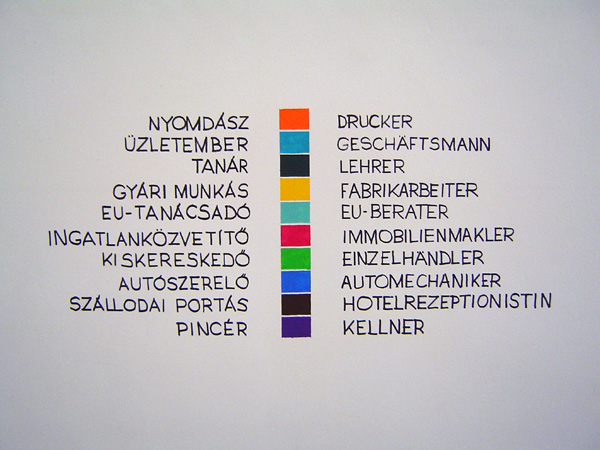
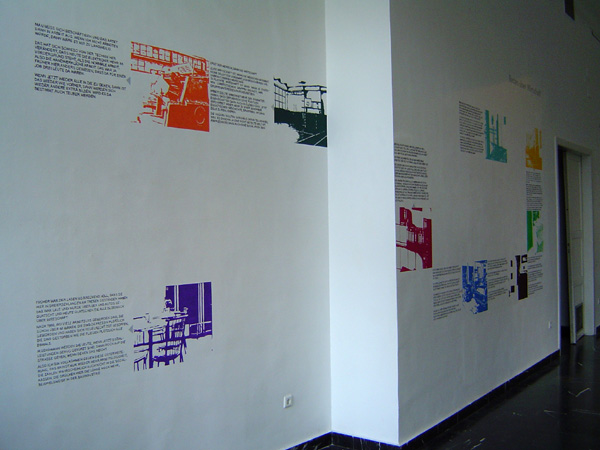
Talking About Economy Big Hope: Miklós Erhardt & Dominic Hislop. Project Description: Thinking and talking about economy is increasingly becoming the exclusive territory of political-professional 'experts'. Through this the question is gradually losing its philosophical aspect and becoming alienated from everyday life. As a consequence of the propaganda generated by the 'experts', economy is largely perceived of as a complex entity that stands for itself, which the outside public are unable to comprehend or control, and about which there is only space for a reactive attitude. The project 'Talking about Economy' is intended to challenge this position. In the process, we asked 10 economic players from Dunaújváros, an economically troubled industrial 'new town' in Hungary each of whom represented different spheres of economic life, to share their thoughts on economy. Dunaújváros, originally called 'Stalin town', was built around a newly developed steel factory as a model of socialist utopian town planning in the 1950s. We posed them the following questions: What is economy's role in society? How would they describe a good economy? How would they describe a bad economy? What is your personal relationship to work? The same questions were then put to workers in the same jobs in Berlin, most of whom have already experienced a fast track economic adaptation during the process of reunification. Two wall paintings and video installations documenting the first part of these two investigations were exhibited in concurrent exhibitions at the ICA in Dunaujvaros ('DEMO') and at Sparwasser HQ in Berlin ('Nomad Job'). The sometimes
banal, sometimes unsure, but also often very strong statements given
by the participants, strengthen notions of independence and personal
resistance and are an attempt to empower participants to engage
with conceptual territory from which they currently alienated.
|
|||||||||||||

 |
|
 |
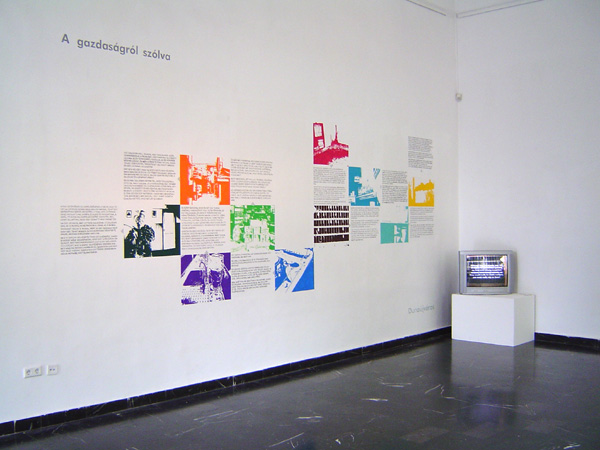 |
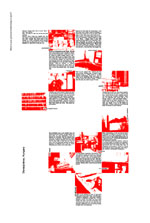
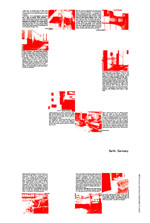
| Documentation of installation at Goethe Institute in Budapest. | |