|
Dreigroschenvideo - Threepenny Video
Big Hope: Miklós Erhardt & Dominic Hislop.
Project Description:
The "Dreigroschenvideo / Threepenny Video" is inspired
by Bertold Brecht's series
of satirical critiques of decayed capitalism: "Threepenny
Opera" and "Threepenny Novel" and the author's related
convictions on aesthetics and political issues. Artists have rarely
achieved such a direct treatment of economic processes as Brecht
managed to do in this play and novel series. Especially in the novel,
the plot is based as much on a detailed account of economic techniques
and behaviour, as it is on psychological and social presentation.
In this sense it has much in common with our recent 'Talking
About Economy' project series, which was also an attempt to
introduce and explore the topic of economy in a direct way within
the domain of visual arts.
The 'Threepenny
Opera' was first presented in 1928 in Berlin. It was a reworking
of John Gay's 'Beggars Opera' written in the early 18th century.
The 'Threepenny Novel' was written later in 1934 as a greatly expanded
version. Set in London, it depicted the criminal activities of a
gang of underworld thieves, headed by Mac Heath ('Mac the Knife'),
an enterprising organisation of beggars, headed by Jonathan Peachum
and the rivalry initiated between them through MacHeath's relationship
with Peachum's daughter, Polly. In their efforts to damage each
others reputations, interests and realise some financial success,
they are prepared to exploit their workforce, bribe corrupt police
officers and threaten those around them with violence. Evenually
they come to see a mutual benefit in forming an alliance and continuing
their previously illegal practices under the legal and more respectable
guise of finance and banking.
"What
is a pick-lock compared to a debenture share? What is the burgling
of a bank compared to the founding of a bank? What is the murder
of a man compared to the employment of a man? ... Nowadays a
man must work within the law; it's just as much fun! ... In
this present age one uses peaceful methods. Brute force is out
of date."
pp 226, "Threepenny Novel", Bertolt
Brecht, Penguin books, 1961. |
Choosing to
work within the context of Budapest, Hungary with it's recent development
of a stratefied society - resulting in the relatively new phenomenons
of a 'business class' and at the same time a very obvious prevalence
of homelessness and begging throughout the city - we didn't seek
to re-represent the same polemics of the play and book, but rather
to try to relate it to a specifc contemporary context. In doing
so we wanted to allow Hungarian equivalents of the the polarised
groups (beggars and businessmen) that constitute the dialectic in
Brecht's writing to defend themselves to the criticisms posed by
Brecht and to question the accuracy and relevance of the 'Threepenny
Opera / Novel' to today's society.
We organised two separate workshops in Budapest
- one with a group of homeless people and the other with a group
of business people. At each workshop, participants were asked to
react to selected scenes from a film version of the "Threepenny
Opera" (directed by
G. W. Pabst in 1931) and
quotes from the "Threepenny Novel". Brecht's depictions of character
types
were related to
participants own specific experiences and Brecht's critique of capitalist
society to the contemporary global economic situation.
Scenes screened and relevant quotes were divided into three themes:
"Peachum's Outfitting Emporium for Beggars" - Peachum's creation
of a business from beggars; "A Demonstration of Human Misery" -
the proposal for a beggars demonstration to upset the coronation
ceremony; and "A Victory for Common Sense" - the final scenes in
which the central characters cease their 'illegal' activities in
order to create a business merger through which they can continue
their profiteering by 'legal', 'business' means. The presentation
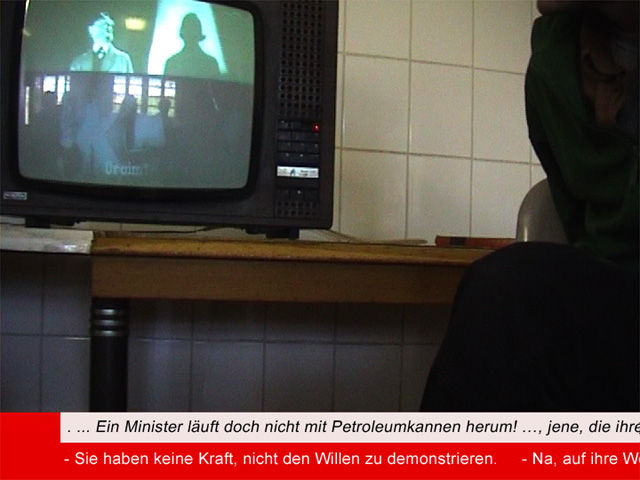
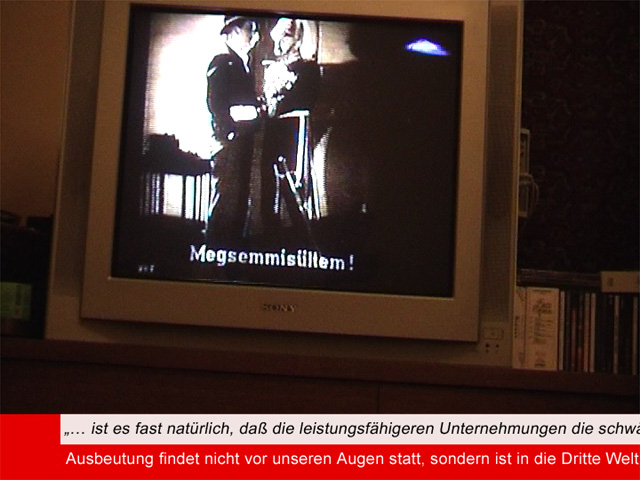
takes the form of a two video installation (one documenting the
homeless workshop and the other for the business) in which audio
and lower streaming texts come from participants comments and the
upper streaming text consists of quotes from the "Threepenny
Novel". The screen image is the televsion set showing the selected
scenes in the two environments where the workshops were held (the
participants themselves, prefering to remain anonymous, cannot be
seen).
Throughout the video, in the background is the sound of an ambient
electronic adaptation of "the Ballad of Mac the Knife".
Sources:
The film, an adaptation of Bertolt Brecht's play "Threpenny
Opera" (Premiered in Berlin, 1928), ia a Tobis-Warner-Produktion,
1931, directed by G. W. Pabst. The screenplay was written by L.
Lania, B. Balázs und L. Vajda. Quotes taken from "Der Dreigroschenroman"
by Bertolt Brecht, (first published 1934). Bertolt Brecht Gesammelte
Werke 13, Prosa 3, Suhrkamp Verlag.
Acknowledgements:
Thanks
to all participants in the workshops (who prefered to remain anonymous)
and staff at the following institutions:
MMSZ - Magyar Máltai Szeretetszolgálat, FSZKI - Dzsa
György hostel, Menhely Alapítvány, C3 - Centre
Of Culture And Communication Goethe-Institut, Budapest Akademie
der Künste, Berlin
Thanks
also to the following for their help:
Boróka Fehér, Zoltán Gurály, Ádám
Lendvai, József Mélyi, Edit Murányi, Elske
Rosenfeld, Mark Rossi, Zsolt Somlói, László
Sugár, Emese Süvecz, Balázs Úrvölgyi,
Ulf Wrede.
Music:
Mark Rossi "Ballad of Mac the Knife" (version)
Contact:
bighope [at] bighope [dot] hu
|