 |
Commonopoly
A project by Big Hope: Miklós Erhardt, Dominic
Hislop, Elske Rosenfeld.
Project Description:
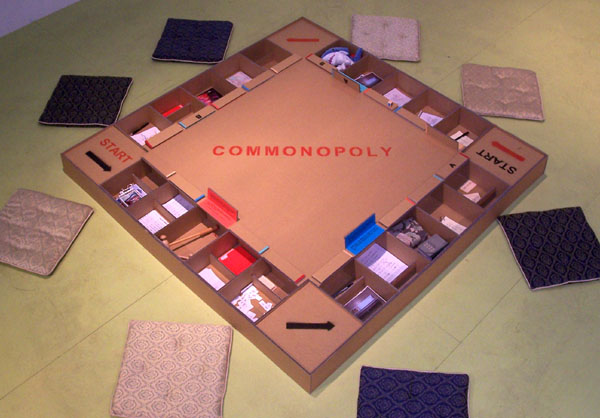
The
name Commonopoly is paraphrased
from Monopoly, understood both as the economic term and
the name of the well-known board game. Unlike Monopoly, the
goal of Commonopoly is not the exhaustion, through monopolization,
of a virtual stock of goods, but rather the expansion and preservation
of a self-propelling sustainable system of recycling, production
and distribution. The word 'common' employed in the name originates
from the notion of 'the commons', that is, the resources such as
air, water, public space etc. that by their nature contradict attempts
at private ownership. Commonopoly is a model of a system where resources
are held in common, avoiding their depletion.
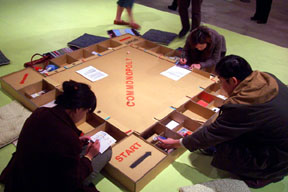
Like other Big Hope projects, the 'artwork'
provides a platform for shared creativity. In this case, the game
exists as a form while players generate the content throughout the
period of presentation. The game has no ideal static state and is
not intended as an object merely to be viewed, rather it invites
participant 'players' to actively engage with it rendering its contents
to be in a continual state of flux. It also resists any 'artistic'
monopolization or ownership of works created. A loose documentation
of creative acts and contributions during the game is made in form
of booklets, much of the participants’ creativity remains
undocumented - as players are invited to remove objects collectively
created and pass them on - distributing them into public circulation
outside the gallery. The concept of the game also develops with
each presentation, integrating the experiences of previous exhibitions.
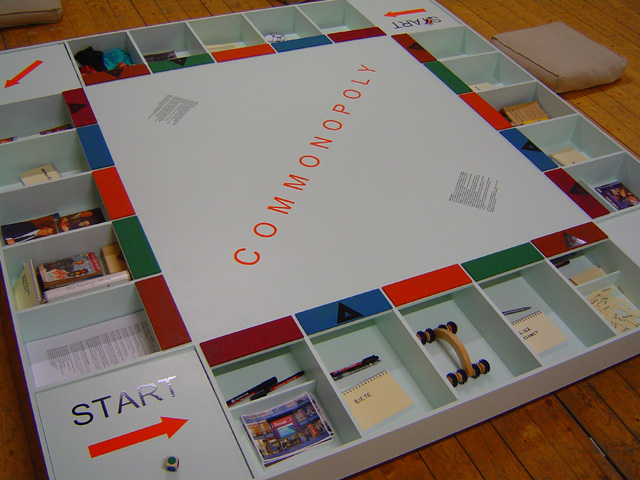
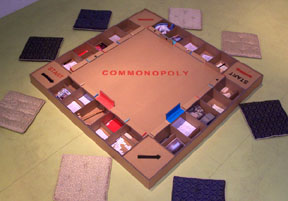
The interactions proposed by different boxes - relating visually
to the property squares landed on in the original game - are designed
to demonstrate and symbolise features and concepts found to be common
in existing examples of small scale practical and large scale theoretical
proposals of economic alternatives to market capitalism. These include
notions of sharing, gift, exchange, collaboration, solidarity, sustainability
and mutual trust.
Sharing is present through the players' participation
in their offering of personal experiences and ideas for the 'economy'
of the game.
The notion of the gift is present in the form of boxes from which
players can take away objects produced collaboratively by previous
players.
Exchange is present:
a.)
as players are invited to offer their personal skills
and capacities as well as to exchange these for other players' skills
and capacities. This aspect of the game is intended to function
as a database for real exchanges between players outside the game.
b.)
in the form of small interactions between different players
as part of the game.
Collaboration is present in 'production chains' integrated
into the process - there are boxes that form a chain through which
a creative product e.g. a concept, a postcard or a sticker, is completed
through a step by step additive process by subsequent players.
Mutual trust is present:
a.)
in that players at several junctures in the game don't
complete a creative product, but leave their contribution to be
modified or transformed and eventually taken away by future players.
b.) in that players are free to take away products of the
game, and trusted to perform an act with them i.e. place a postcard
in a free postcard box or put a sticker up somewhere in public space
etc.
Solidarity is the underlying behavioral foundation of
the game, present in every player's engagement to sustain Commonopoly.
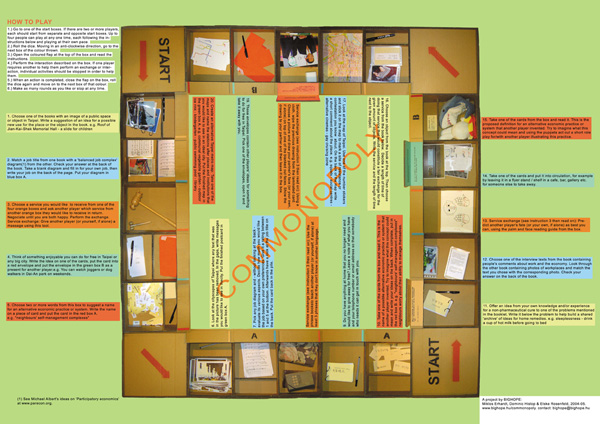
Colour Code:
The different interactions have been grouped into five colour coded
categories to encourage players to engage with the many different,
sometimes overlapping, sometimes contradictory aspects of alternative
economic practices/theories
| purple |
Commons
reclaiming public space as a communal resource providing access
to knowledge as a communal resource |
| blue |
Sharing
pooling resources, sharing and exchanging skills |
| red |
Exchange
negotiating exchanges of services – a mini exchange ring |
| green |
Free
giving or receiving something for free |
| brown |
Theory
learning and thinking about different alternative economic theories |
How
to Play:
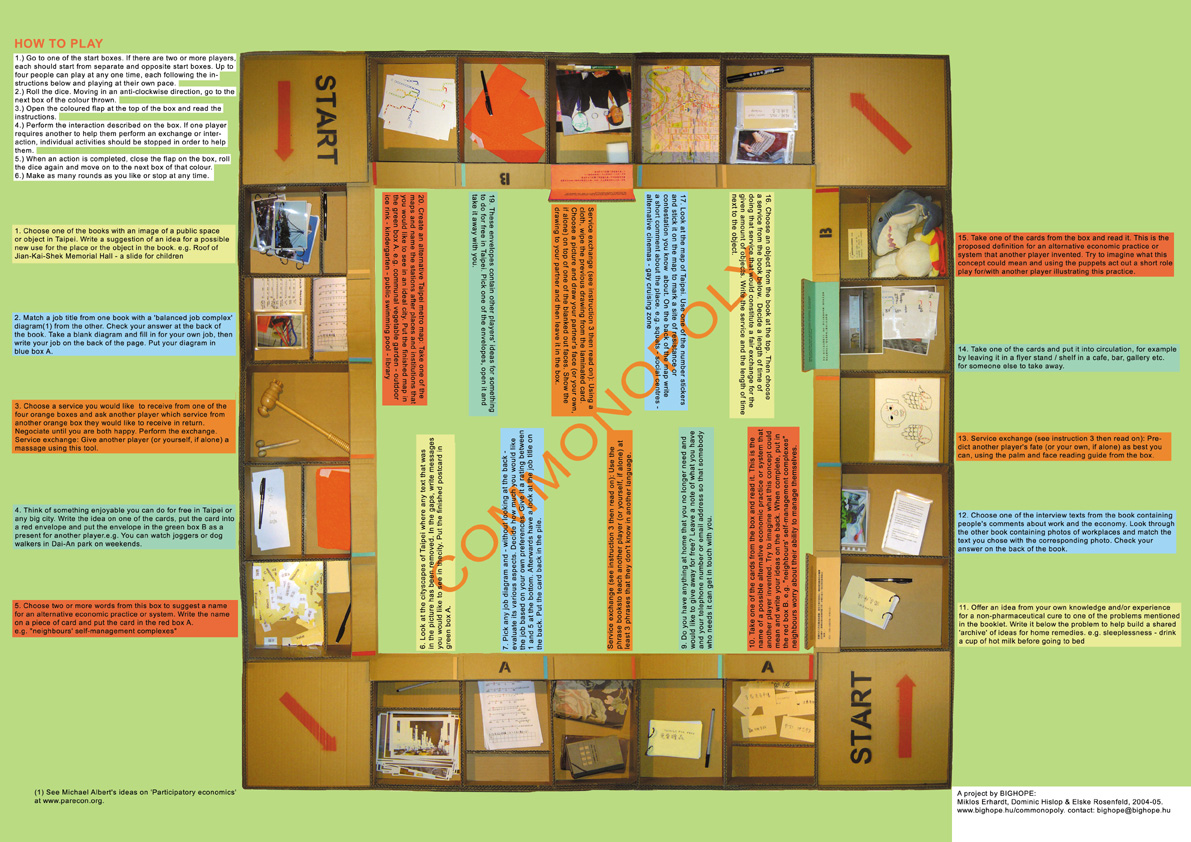
1.) Go to one of the start boxes. If there are two
or more players, each should start from separate and opposite start
boxes. Up to four people can play at any one time, each following
the instructions below and playing at their own pace.
2.) Roll the dice. Moving in an anti-clockwise direction, go to
the next box of the colour thrown.
3.) Open the coloured flap at the top of the box and read the instructions.
4.) Perform the interaction described on the box. If one player
requires another to help them perform an exchange or interaction,
individual activities should be stopped in order to help them.
5.) When an action is completed, close the flap on the box, roll
the dice again and move on to the next box of that colour.
6.) Make as many rounds as you like or stop at any time.
Instructions
for each box:
click here
to view image with instructions
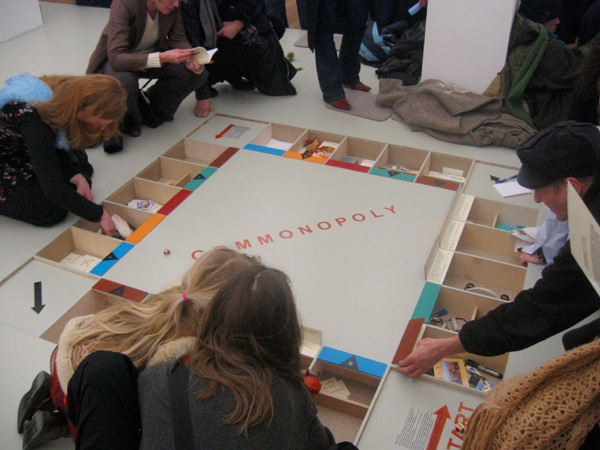
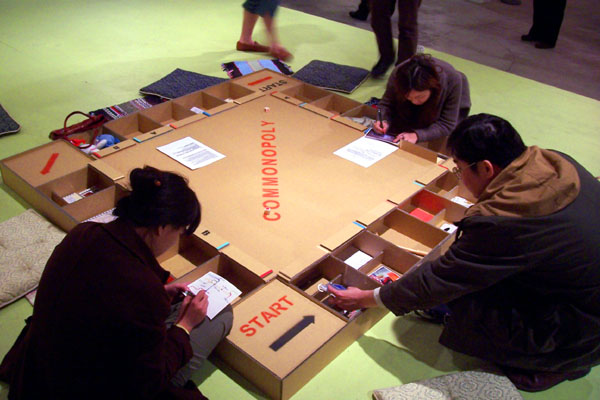
Installation
shots:
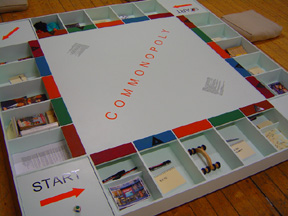 1
1 |
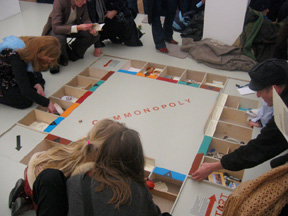 2
2 |
 |
 |
| |
Acknowledgements:
(In Berlin) Thanks to Jens and everyone at the Umsonstladen
(Brunnenstrasse 183, Berlin) for discussing their project and allowing
us to use objects from their shop, Renate from the Kreutzberger
Tauschring for explaining how the tauschring works, Silke from Berlin-Umsonst
for information about various Berlin based campaigns concerning
public space, Magdalena for all the useful information about alternative
economies that have evolved recently in Argentina and Christoph
for sharing ideas from his studies of economic theories.
(In Linz) Thanks to Martin Windtner from the ÖGB for
information about social conflicts and political protest in Linz,
to Mr. Rummersdorfer from SOMA for explaining how the Sozialmarkt
Shop and Café work, to Susanna Rothmayer from 'time-Zeittauschbörse'
for telling us about their exchange ring project, to Sebastian Lasinger
from the ASF organisation group for discussing conflicts around
public space in Linz and to Anatol from KAPU for an introduction
to alternative cultural projects in Linz.
(In madrid)
Thanks to Tomas & Mariamaria.
(In Taipei)
Thanks to Manray, Maren, Grace, Sandra, Fang, Vincent & Nikita.
Contact:
bighope [at]
bighope [dot] hu
Links:
Berlin Initiatives:
http://www.umsonstladen.info
Website of the Free Shop in Berlin. Information about the Berlin
shop and the free shop idea. GERMAN/ENGLISH
Webseite des Berliner Umsonstladens. Information über den Laden
und die Umsonstladen Idee. DEUTSCH/ENGLISCH
http://www.tauschringe-berlin.de
Information about all the Tauschringe (Exchange Rings) in Berlin
and Germany. How does a Tauschring work? Introduction to the philosophy
behind the Tauschring idea. GERMAN
Informationen über alle Tauschringe in Berlin und deutschlandweit.
Wie funktioniert ein Tauschring Einführung in the Tauschringphilosophie.
DEUTSCH
http://www.berlin-umsonst.tk
Berlin Umsonst: Information about projects and events dealing with
issues around public space and public services in Berlin. GERMAN
Berlin Umsonst: Informationen über Projekte und Veranstaltungen
zu Fragen des öffentlichen Raum und öffentlicher Dienstleistungen
in Berlin. DEUTSCH
http://www.squat.net/pirat/pirat
Different groups and initiatives around (legalised) squats. Information
about projects and events. GERMAN
Zusammenschluß verschiedener Initiativen, Koordination von
Aktionen in und um (ehemals) besetzte Häuser. DEUTSCH
http://www.rts.squat.net
Reclaim the streets: Overview of events and projects dealing with
the appropriation and the defense of public space. GERMAN
Reclaim the streets: Übersicht Ÿber Aktionen und Projekte,die
sich mit der Aneignung und Verteidigung des öffentlichen Raumes
beschäftigen. DEUTSCH
http://lotec.squat.net
Lotec: Free workshops and Information about the internet and software.
Introduction to Linux (Open Source Software) . GERMAN
Lotec: Kostenlose Workshops und Informationen zu Internet und Software.
Einführung in das Linux System (Open Source Software). DEUTSCH
Austrian initiates in and around Linz:
http://www.tauschkreis-kaernten.at/index2.html
http://www.talente-noe.at/
http://home.pages.at/lets-wien/index.html
http://www.sozialmarkt.at
http://www.monochrom.at/fressen/
http://www.alles-und-umsonst.de/
http://www.umsonstladen.info/freeshops.html
http://www.kapu.or.at/
http://www.qujochoe.org/main.html
http://www.stwst.at/default.htm
http://www.servus.at/maiz/
Theory/Theorie
http://www.parecon.org/
Interviews and articles about Parecon: Participatory Economics.
ENGLISH
http://www.zmag.de/thema.php?topic=9
Interviews und Artikel über Parecon: Participatory Economics.
DEUTSCH
http://www.republicart.net/art/alternative.htm
Collection of transcripts from interviews with leading proponents
of contemporary alternative economic theories. ENGLISH
http://www.newint.org/issue278/contents.html
Articles on the topic of 'Green Economy' ENGLISH
http://www.yesmagazine.com/18Commons/rowe.htm
Article on concept of 'the commons'. ENGLISH
http://www.theecologist.org/archive_article.html?article=394&category=43
http://www.theecologist.org/archive_article.html?article=266&category=43
Some articles from on the economic alternatives that have evolved
in Argentina in response to the economic collapse in 2001. ENGLISH
http://www.socio.demon.co.uk/magazine/5/5barbrook.html
http://www.gnu.org/philosophy/shouldbefree.html
http://www.zmag.org/content/print_article.cfm?itemID=4894§ionID=13
http://wizards-of-os.org/
Articles and sites on free software and the economy of the internet.
ENGLISH/ DEUTSCH
Other:
http://www.stickernation.net
http://www.urban-art.info
Sites documenting graffiti and stickers in Berlin and other cities.
ENGLISH/ DEUTSCH
|